%3Aformat(png)&w=750&q=75)
%3Aformat(png)&w=3840&q=75)
%3Aformat(png)&w=3840&q=75)
%3Aformat(png)&w=3840&q=75)
%3Aformat(png)&w=3840&q=75)
%3Aformat(png)&w=3840&q=75)
%3Aformat(png)&w=3840&q=75)
%3Aformat(png)&w=3840&q=75)
%3Aformat(png)&w=3840&q=75)
%3Aformat(png)&w=3840&q=75)
%3Aformat(png)&w=3840&q=75)
%3Aformat(png)&w=3840&q=75)
%3Aformat(png)&w=3840&q=75)
%3Aformat(png)&w=3840&q=75)
%3Aformat(png)&w=3840&q=75)
%3Aformat(png)&w=3840&q=75)
%3Aformat(png)&w=3840&q=75)
%3Aformat(png)&w=3840&q=75)
%3Aformat(png)&w=3840&q=75)
%3Aformat(png)&w=3840&q=75)
Before there was any house to speak of, let alone before a single shovelful of earth was moved, the safety of the tree had to be accounted for. Builder Josh Brooks, owner of Brooks Construction Group, explained that a more than 100-foot circle surrounding the tree was mapped out (roughly the entire width of the tree’s canopy and thus root system), and for the duration of the build, no one was to set foot within that ring. Protecting the tree was paramount.
With the live oak’s well-being ensured, the home’s planning and building could truly commence. For that, the team essentially worked backward, starting not with the house, but at the road, reverse engineering from the arrival experience, again with the tree taking a starring role.
“I think my favorite part of the whole house is the entry sequence, and that came from the tree,” Grassi said. “It was a bit like movie making.”
“When you come off the street, you make a turn in and there are two outbuildings, the garage and a guest house. We pushed them tight together and created a narrow slot,” Grassi said. “You approach that and you have to squeeze through. It's a little tight, but that was intentional. Then you go around the tree to get to the front door. So, the tree becomes the presence. The tree, it's the focal point of the whole complex.”
But for the “whole complex,” as Grassi describes it, to work, the house had to fit in with this purposeful, of-the-land-and-area aesthetic. That is where the home’s design and build rises to great heights, despite its somewhat modest initial appearance.
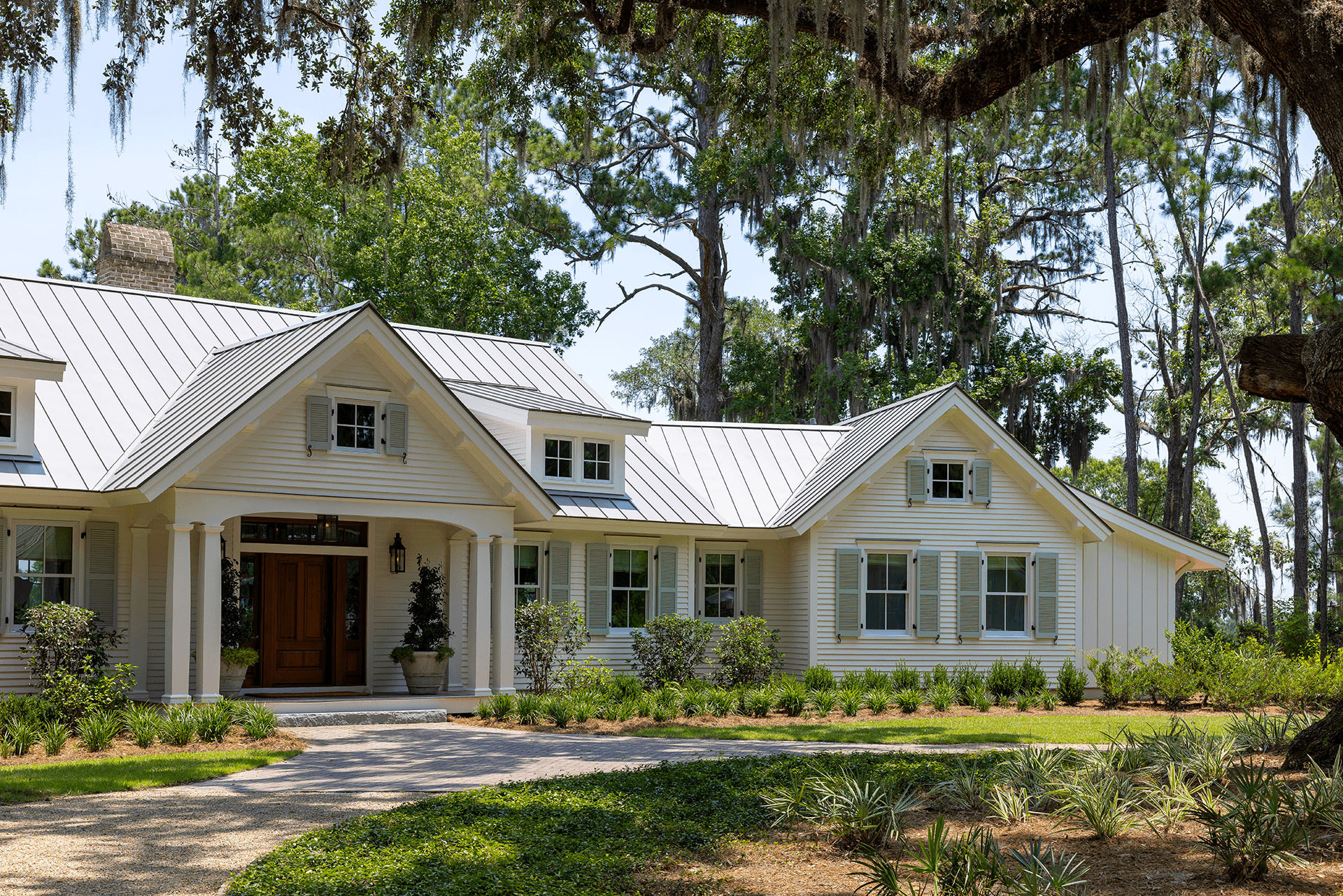
“Lowcountry houses were generally ramblers,” Grassi explained. “They were small houses that were added to over the decades and over the years. They were generally one-story houses, raised a little bit just to get out of the water. So, that was the model for the house.”
The home’s unassuming profile belies its depth of detail, character, and intentionality. On the outside, three gas lamps frame the main entrance, while two flank the side entrance, harkening back to a pre-electric, pre-motion light era. Once inside, beadboard, transoms, and crown molding are just some of the time-honored features that add tasteful Southern detail.
Views to the water come courtesy of classically designed Marvin Ultimate Double Hung windows, complete with divided lite patterns echoing a storied style, while Marvin Ultimate French doors swing open to reveal the rear of the home that’s almost entirely porches and decking. The house makes inside-outside living almost impossible to avoid.
“You don’t have to really make a decision to go outside,” Grassi said, “With the porches, you’re right there.”
For both Grassi and Brooks, they found a partnership and collaboration on the home rooted in a respect for nature, a dedication to place, and a close consideration of detail.
“I always go by this saying,” Brooks shared, “’They will quickly forget how long it took you to do something, but they will never forget how well you did it.’”
For more on this lowcountry hideaway, including stunning views of its famed Spanish moss-covered live oak, its waterfront setting, its sun-lit spaces, and why Grassi knows Marvin “can do it,” check out this case study video.
Case Study Video
Guy Grassi, President and Architect, Grassi Design Group: It's important, I think, for all architecture to be a part of the place that it lives. The background is sort of the macro: what's in the general area around it. And then you dive into the micro: what's on that piece of property, what's next door, what's within five blocks. You look at all those things and they all impact how you're going to start.
Josh Brooks, Owner and Builder, Brooks Construction Group: This part of Georgia is the heart of the lowcountry. We're typically sitting about 15 to 20 feet above sea level. Savannah's just over the state line from South Carolina, so it's a kind of a dynamic area. It's a really great place to live.
Grassi: The way, I think, you make a house feel like it's part of the land is to engage it. The live oak tree that's at the center of this property is a really spectacular tree. It's a hundred feet in diameter with the canopy, the trunk of the tree is seven or eight feet in diameter, and it really dominates the landscape.
Brooks: It's approximately 450- to 500-plus years old. So, the first thing we had done was an assessment by a local expert, and then we came up with a nutrient plan. This was before we ever broke ground. Set a perimeter around the entire tree. That area was off limits the entire build.
Grassi: The whole complex is sort of built around the tree and just outside of the canopy. So, all of the structures and the tree sort of become one, if you will.
When I first met with the owners, they talked about wanting a smallish house, so it's a two-bedroom house. They really wanted a one-story house. They're going to age-in-place here. It was really a site that wanted to be a less formal style house. That actually fit with what the owners were after. And so we looked at more lowcountry houses as inspiration.
Brooks: This home in particular, the style is more of a “craftsman lowcountry,” as we call it, type of architecture, which takes advantage of roof lines, shadow lines, providing shade around the building. Sort of a predecessor to when before people had air conditioning.
Grassi: One of the things that is somewhat unique about this house are the arches. The first experience you have is the pergolas that come off of the guest house and the garage. The roofs of the garage have a slight curve to them, and it starts the process of your brain thinking about things with a little bit of a curve. And then you come in the front door and then there's a series of elliptical arches. Even the fireplace has a little arch to it. It's a theme that works throughout the house, so it's not just one detail, it's sort of a collection of them.
Brooks: There are two outbuildings. One is a garage and the other is just a small studio apartment. They wanted the ability for their guests to have their own separate living space, but be on property. It's sort of a little atrium that has two enormous elliptical windows on the front and the back. It's a really great little jewel box.
The magic of a house like this is when the relationships come together. There are a few partners that we have that we feel like are more a tangible partner. Marvin's one of those.
Grassi: What we love about Marvin is that we can generally get anything we want from them. We're able to get very narrow profile doors, so that the rails and stiles are narrow. We can get inswing windows and outswing windows, like push-out windows. Generally, if we want to do something, Marvin can do it.
Brooks: Ultimate was a great choice for us because of the sizing, the architectural details, and the colors that were available.
Grassi: The Ultimate collection is a good balance of a traditional look with the muntin profiles, the SDLs. The aluminum cladding is great because it protects the window and minimizes the maintenance on the exterior of the house. So, it's sort of the right balance of all of those needs.
Being able to satisfy the client's needs, the interior designer's ideas, the building codes and the wind speeds, and all these things. That's the magic of architecture, right? It's how do you make all that work? And it's all about being open-minded and not forcing one architectural style, one configuration, one way to do things. It's coming up with the best solution for that particular site, in that particular town, in that particular development, in that particular part of the country.