%3Aformat(png)&w=750&q=75)
%3Aformat(png)&w=3840&q=75)
%3Aformat(png)&w=3840&q=75)
%3Aformat(png)&w=3840&q=75)
%3Aformat(png)&w=3840&q=75)
%3Aformat(png)&w=3840&q=75)
%3Aformat(png)&w=3840&q=75)
%3Aformat(png)&w=3840&q=75)
%3Aformat(png)&w=3840&q=75)
%3Aformat(png)&w=3840&q=75)
%3Aformat(png)&w=3840&q=75)
%3Aformat(png)&w=3840&q=75)
%3Aformat(png)&w=3840&q=75)
%3Aformat(png)&w=3840&q=75)
%3Aformat(png)&w=3840&q=75)
%3Aformat(png)&w=3840&q=75)
%3Aformat(png)&w=3840&q=75)
%3Aformat(png)&w=3840&q=75)
%3Aformat(png)&w=3840&q=75)
%3Aformat(png)&w=3840&q=75)
Design Ideas
Field of Vision: Marica McKeel
The architect and Studio MM founder checks in to share everything from what’s the foundation of her work to how client knowledge has changed collaboration.
With its densely wooded lots, rolling hills, and panoramic views, the Hudson Valley seems like the perfect home base for someone whose architectural aesthetic is focused on a fine balance between what’s happening on the outside and what you see from the inside. Finding that equilibrium is exactly what Studio MM founder and principal Marica McKeel is after.
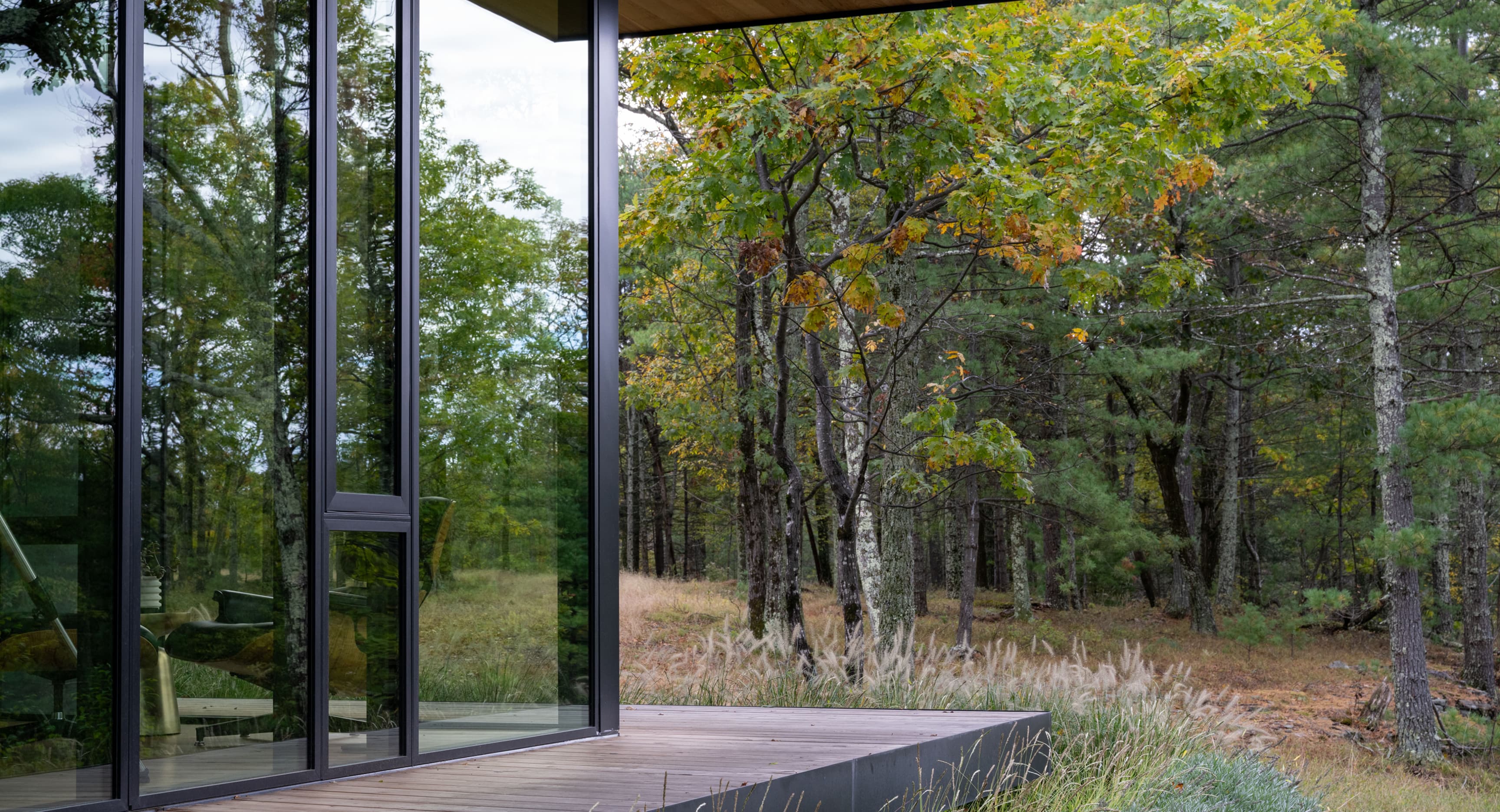
“So much of our work is really about the indoor-outdoor connection,” McKeel said.
Founded in 2010, McKeel’s firm is an award-winning design studio that continues to set a standard for how residential architecture lives in harmony with its place. With projects like Tranquil Abiding, Kaat Cliffs, and her stunning home-and-office, Via 43, McKeel’s designs continue to lean into their surroundings, celebrating and showcasing the land that surrounds them.
McKeel graciously took the time to participate in this “Field of Vision” feature, sharing her perspectives on topics including what it takes to build a successful team and business, how Instagram and Pinterest have changed client collaboration, and how what comes before the trace-paper-and-pen work is perhaps the most important part of the design process.
Note: This is part of the ongoing Marvin “Field of Vision” series. These stories will shine a light on some of America's architectural leaders, focusing on their history in the industry, design inspirations, lessons learned along the way, and more.
Q: Attention to detail is something that we talk a lot about at Marvin, and I'm guessing something you hang your hat on, too. What does attention to detail mean for you and your business?
A: Details are one of the most important parts of any home, of all architecture. It's really the way everything comes together. I would say that for us, now, with Studio MM, is we've learned so much. We learned so much on every project that our details are just getting better and better, and the way we're able to really detail a project and put a house together, it's well beyond where we started and it's elevating our architecture.
Q: What are some foundational elements of your work, like, "Without this, it doesn't work."?
A: I think that goes back to bringing the outdoors in. So much of our work is really about the indoor-outdoor connection, so it really is about the place where we're designing. That's the other thing is, I think, especially when we're designing in the Hudson Valley, which most of our work is there, it's almost easy to design. It's just this gorgeous landscape, so, of course, you just really want to invite the outdoors in.
Q: How do you balance your aesthetic and your feelings about architecture with the client's requests and ideas?
A: Most of our clients come to us because they've seen our work, and they know how we design and what we design. I think there's a lot of them relying on our design. But at the same time, every single project is so different, and it's because of what the clients bring. Because of that collaboration with the clients, I think they really direct the way the architecture goes, the way the design goes. I think something that I pride myself on is a lot of our work is very, very different because it's not that we have this heavy hand as the designer, it's more of that we can listen and we really want to bring forward what it is they're looking for in their home.
So many of our houses, we have stucco box houses, and we have long, linear wood houses, they're just so different because of the clients.
Q: You have so much going on. How do you organize your time? Do you have any sort of secrets or tools or things you use to keep yourself on track?
A: It's funny. So many people say that architects are supposed to be very organized, and I think that I would say I'm not a very organized person. However, before I hired the very first employee that I ever had, I realized that I had to be absolutely organized. I had to have systems in place, I had to have all my [stuff] together before I would ask anybody to work with me. So therefore, that sort of forced me to actually do all those things and really be organized.
While it's not a strong point, I think it's something that has been critical for my business. Even working by yourself, even entrepreneur, to having an entire firm, it is absolutely that organization that has made it work. Now, we use online systems, we use cloud systems, and that way we can all sort of function very well together.
Q: How do you start your projects? Are you a paper sketcher? Are you a computer, iPad with a pen? How are you starting?
A: Well, I'm a little bit old school, I guess, so definitely tracing paper and pen is really how I like to start a project. Just to back up a little, I'd say the way we actually start our projects is one of my favorite parts about our process: We actually start with a questionnaire. We're starting with asking the client how they live in their home, how they live, where they have coffee in the mornings, where they eat dinner at night. We really start with those kind of questions, and I always try not to design anything even in my head. I'm not thinking about anything until I'm really getting their feedback, and then I can start to design. I would say from that point, definitely it's tracing paper and pen and big picture sketching and then obviously just designing that through.
Q: The “How do you live now?” versus “How do you want to live in this project?" seems so essential. How do you approach that idea with clients?
A: We actually do both. It's important to know how they live now because that is something that's a bit more tangible for them, and that'll tell us a lot about their daily lives, but we definitely ask questions about how they're going to live. We have a lot of clients. Some clients are downsizing, so that's different to think about. Some clients are upsizing. We're thinking about the future as well. We're designing flexible space. We're designing space that can adapt with them. So that's something where we're asking them to think about how they would be living in this home, but both.
Q: Do you feel clients are better informed when they come to you now than they used to be because they have Instagram, Pinterest, etc.?
A: I actually do think that the clients having more information, having everything at their fingertips today is somewhat helpful. They see a lot more. They can talk or show us a lot more about what they're looking for, what they like, what they don't like, so we use those. We use that as, "Please bring us. Please send us all that information."
We put a lot of information online. We talk about our work, we talk about how we work, we talk about everything our clients should be thinking about. We try to give them a lot of information so that they're well-educated, they're very confident when they come to us. So, in a way, that confidence is really helpful because they feel like they're at the table with us, and it's not just we know what we're doing. We would much prefer that we're all on this together on the same page.
Q: Do you talk about windows and doors with clients at that sharing stage? How do you bring that discussion to them?
A: Sometimes the clients know exactly what they want, and they will say they know what windows they want. Most of the time, I would say we are the ones recommending, and we still would recommend even if they think they know what they want. We'll still have that conversation. Windows are such an important part of our design, it's such a large part of our design, and it's part of the reason that these clients come to us. They see our projects with large windows, and that's what they're looking for. If we're not having it because of the thermal capacity or because of the envelope, we're having that conversation because of the products or the ease or the capability to do larger sizes.
Q: You started out on your own, but then it turned into this amazing adventure of heading up your own firm. What stands out when you think back on that?
A: When I went out on my own, I had no idea that I would have a firm one day. The goal was just to build houses. [But] in order to keep up with my clients, I knew I actually needed help. So, I hired my first employee, and then I hired my second employee very quickly [after]. Those two people have been the absolute reason that this firm has grown and that we have become who we are. ... The thing that I didn't know about growing a firm was really hire people that are better than you. Everybody around you should be better than you — and they are — and that is the reason that we've been successful.
Q: What excites you about the young architects that you meet?
A: It's always exciting when we get a young person around us, even whether it's a new employee or whether it's at [Custom Residential Architects Network]. It's inspiring to see their energy and their excitement for the profession. I can kind of remember when that was me, and I still have that, but it's really awesome to see that in a young person because, on one hand, I remember feeling that way. On another hand, where I am now, I can think like, "Wow, how can I inspire that person further?" Or, "How can we just make sure as a profession that we're continuing to keep them excited about it, stay in, stay with us, and keep them growing?"
Q: What are your goals going forward?
A: The goal, I think, is to continue to grow as we have been. I would say it's a good, steady, slow growth in the sense of learning. It's like we are as a team really trying to teach ourselves, always learning. Even in the details, it's, "How can we be better?" I feel like we are getting better and that feels great. I guess, short-term goal, that is to continue that.
Long-term goal is to really bring a lot of the younger people in the firm up to running projects as if they're running the firm. That's the goal.
For more “Field of Vision,” check out this interview with highly accomplished architect and president of Grassi Design Group, Guy Grassi.